The ocean has absorbed around a quarter to a third of human CO2 emissions, and its surface waters are now about 30% more acidic than before the industrial era. Here is the science of the 'other CO2 problem' and why it matters.
Elena MarshEnvironment & Climate Correspondent•••5 min read
TL;DRThe ocean has absorbed roughly a quarter to a third of human-caused CO2 emissions since…Ocean surface waters are now about 30% more acidic (a 0.1 drop in pH) than in…Acidification makes it harder for corals and shellfish to build calcium carbonate shells…
Read aloud by your browser — nothing is downloaded or tracked.
Context: the climate problem you hear less about
Climate change dominates environmental coverage, but it has a lesser-known chemical twin driven by the very same emissions: ocean acidification, sometimes called "the other CO2 problem." While the world focuses on rising temperatures, the ocean has been quietly absorbing a large share of our carbon dioxide and changing its chemistry as a result — with consequences for marine life that are serious, already measurable, and largely irreversible on human timescales. Understanding acidification matters because it's a distinct threat that reducing emissions addresses but adapting to warming does not, and because it affects food webs, fisheries and ecosystems that billions of people ultimately depend on.
The data: the chemistry and the numbers
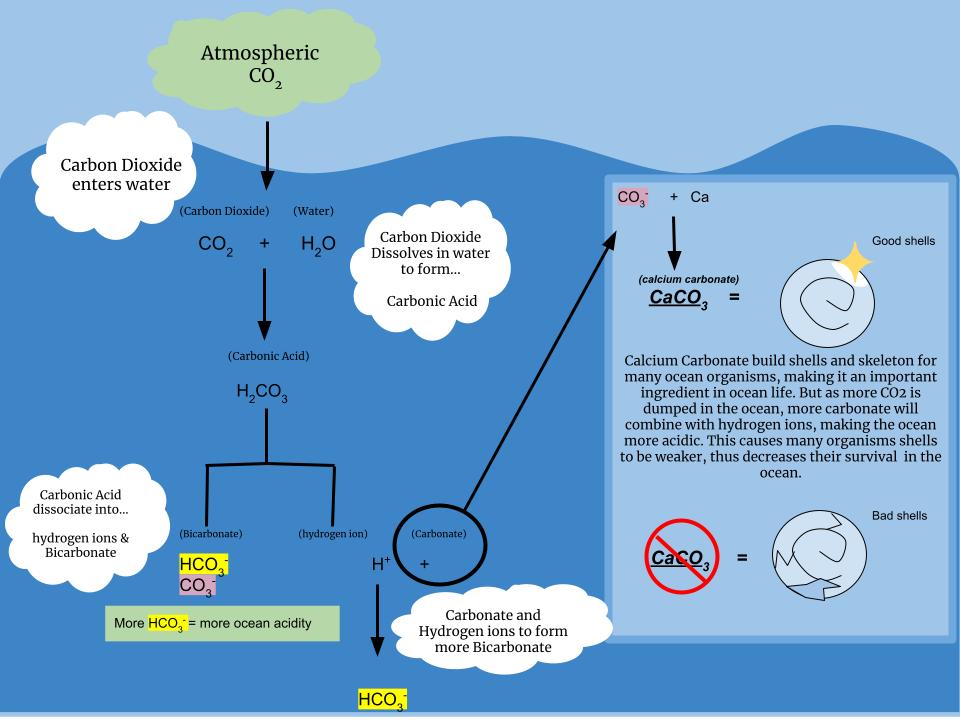
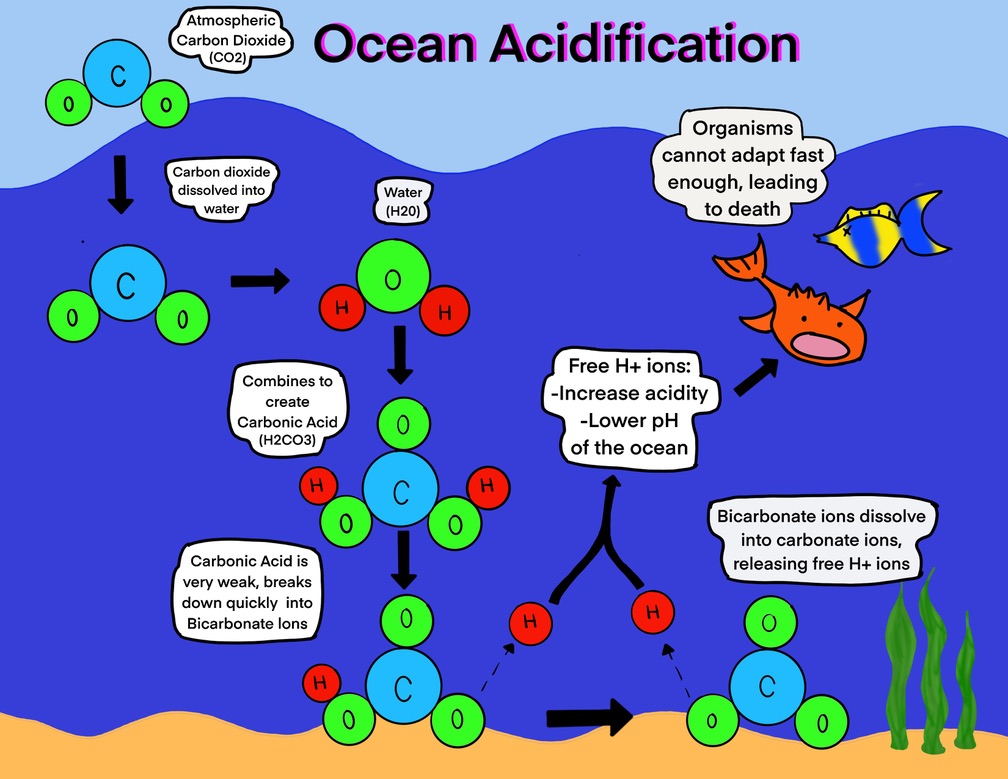
The mechanism is straightforward chemistry. The ocean has absorbed roughly a quarter to a third of human-caused CO2 emissions since the industrial era. When CO2 dissolves in seawater, it reacts to form carbonic acid, lowering the water's pH and raising its acidity. This is a direct chemical consequence of rising atmospheric CO2, separate from the warming those same emissions cause.
The scale is significant, even if the numbers sound modest at first:
Measure
Figure
Share of human CO2 absorbed by the ocean
~a quarter to a third
Increase in surface-water acidity since pre-industrial times
~30%
Corresponding pH change
~0.1 drop
Reason a small pH change matters
The pH scale is logarithmic
That last point is crucial: because pH is a logarithmic scale, a drop of 0.1 represents roughly a 30% increase in acidity. And this is happening faster than at almost any point in the geological record, giving marine ecosystems little time to adapt.
What's changing: the impact on marine life
The core biological threat is to organisms that build shells and skeletons from calcium carbonate. More acidic water makes it harder for corals, oysters, mussels and the tiny plankton at the base of the food web to form and maintain these structures, and in severe cases can begin to dissolve them. Because these organisms underpin entire marine ecosystems — plankton feed vast numbers of species, and coral reefs support around a quarter of all marine life despite covering a tiny fraction of the ocean floor — damage to them ripples outward through food webs. The IPCC has identified ocean acidification as a major threat to marine ecosystems this century, and shellfish industries in some regions have already reported real impacts, making this an economic problem as well as an ecological one.
"Ocean acidification is one of the clearest, most direct consequences of our carbon emissions — it's simple chemistry, it's measurable, and it's happening now. Unlike some climate impacts, there's no scientific debate about the cause. The CO2 we emit ends up changing the chemistry of the sea." — a summary consistent with how the Royal Society and NOAA describe the science.
Ocean acidification might feel remote, but its consequences reach human life in concrete ways. Fisheries and shellfish industries — significant sources of food and livelihoods worldwide, including around UK coasts — are directly exposed, and damage to marine food webs affects the wider ocean systems that provide a large share of the world's protein. Coral reef decline, driven by acidification alongside warming, threatens the fisheries and coastal protection that reefs provide to hundreds of millions of people. And because acidification is a direct chemical result of CO2 emissions, it strengthens the case for cutting them: it's a harm that adapting to warmer temperatures does nothing to address, and that only emissions reduction can slow. For the closely related climate picture, our explainers on how carbon capture works and what a carbon sink is cover the wider carbon cycle the ocean is part of, and our piece on climate-driven extreme weather in the UK covers the more visible face of the same underlying problem.
It's worth situating acidification within the ocean's broader role in the climate system, because the two are connected. The ocean has done humanity an enormous, unacknowledged favour by absorbing both a large share of our CO2 and more than 90% of the excess heat trapped by greenhouse gases — dramatically slowing the pace of atmospheric warming we would otherwise have experienced. But this service comes at a cost paid by the ocean itself: warming waters, which hold less oxygen and disrupt marine life and currents, and acidification, the chemical change described here. In other words, the ocean has been buffering us from the full force of our emissions, and acidification is part of the bill. This framing matters because it counters a comforting misconception — that because the ocean absorbs so much CO2, emissions are somehow less urgent. The reverse is true: the ocean's absorption is finite, comes with serious consequences, and is not something we can rely on indefinitely without profound damage to the marine systems that sustain life on the planet.
What to watch next
Watch the ongoing monitoring of ocean pH by scientific bodies like NOAA and the IPCC, which track the pace of acidification and its regional variation — some areas, including colder waters that absorb more CO2, are acidifying faster than others. Watch the effects on specific fisheries and shellfish industries, which are among the earliest and clearest economic warning signs of the wider ecological impact. And watch the research into which species and ecosystems can adapt and which cannot, since the ability of marine life to cope with rapid acidification is a key uncertainty in projecting the ultimate impact. The fundamental point, though, is settled and sobering: ocean acidification is a direct, largely irreversible consequence of CO2 emissions, unaddressed by any response other than cutting those emissions — which is precisely why it deserves far more attention than it typically receives alongside its better-known twin, global warming.
Frequently asked questions
What actually causes ocean acidification?
When the ocean absorbs carbon dioxide from the atmosphere — as it has done with roughly a quarter to a third of human CO2 emissions — the CO2 reacts with seawater to form carbonic acid, lowering the water's pH and making it more acidic. This is a direct chemical consequence of rising atmospheric CO2, separate from (though related to) climate warming. It's sometimes called the 'other CO2 problem' precisely because it's driven by the same emissions as global warming but is a distinct chemical process with its own set of consequences for marine life.
How much more acidic has the ocean become?
Ocean surface waters are now about 30% more acidic than in pre-industrial times, corresponding to a drop of roughly 0.1 in pH. That may sound small, but the pH scale is logarithmic, so a 0.1 decrease represents around a 30% increase in acidity — a substantial and rapid change in chemical terms, occurring faster than at almost any point in the geological record. The IPCC and ocean scientists monitor this closely because the rate of change gives marine ecosystems little time to adapt.
Why does acidification threaten marine life?
More acidic water makes it harder for organisms that build shells and skeletons from calcium carbonate — corals, oysters, mussels, and tiny plankton at the base of the food web — to form and maintain those structures, and in severe cases can cause them to dissolve. Because these organisms underpin marine food webs and ecosystems (plankton feed vast numbers of species; coral reefs support around a quarter of all marine life), damage to them ripples outward. Shellfish industries have already reported impacts in some regions, making this an economic as well as ecological problem.
Can ocean acidification be reversed?
The only real solution is reducing CO2 emissions, since acidification is a direct chemical result of the ocean absorbing atmospheric CO2. If emissions fall, the process slows and, over very long timescales, ocean chemistry can recover — but the ocean responds slowly, so acidification already locked in will persist for a long time. There is no practical way to 'de-acidify' the entire ocean artificially at scale. This makes acidification one of the clearest arguments for cutting emissions: it's a consequence of CO2 that no amount of adaptation to warming addresses.
We use cookies, device fingerprinting and cross-device tracking to personalise content, serve targeted advertising, and analyse how you use our site across your devices. By clicking Accept all you consent to the use of these tracking technologies. Your data may be used to build a profile of your interests and show you personalised ads on other sites.
Privacy policy
Before you go
Get the Daily Briefing
Independent reporting, new on the hour, with the sharpest headlines in one email.




Join in — free. Comments on Daily Junction are for members, so real names stay rare and bots stay out.
One field. We email you a 6-digit code — no password needed. Your comment is kept while you do it.
Under 13? You’ll need a parent’s OK first — it takes them one click.