

For a few minutes, in a narrow strip of the world, day turns to twilight. The temperature drops, birds fall quiet, stars appear, and a black disc ringed with ghostly light hangs where the Sun should be. People travel across continents to witness it, and many describe a total solar eclipse as among the most extraordinary sights in nature.
Behind the spectacle lies a simple piece of cosmic geometry — and a coincidence so improbable it almost seems designed. Here is how solar eclipses happen.
What a solar eclipse is
A solar eclipse happens when the Moon passes directly between the Earth and the Sun, blocking the Sun's light and casting the Moon's shadow onto the surface of the Earth.
That is the entire mechanism. The Moon is, of course, far smaller than the Sun, but it is also vastly closer to us. As it orbits the Earth, there are moments when it slips precisely into the line between us and the Sun, and for anyone standing in its shadow, the Sun is temporarily hidden. It is, in effect, the Moon casting a shadow you can stand inside.
The remarkable coincidence
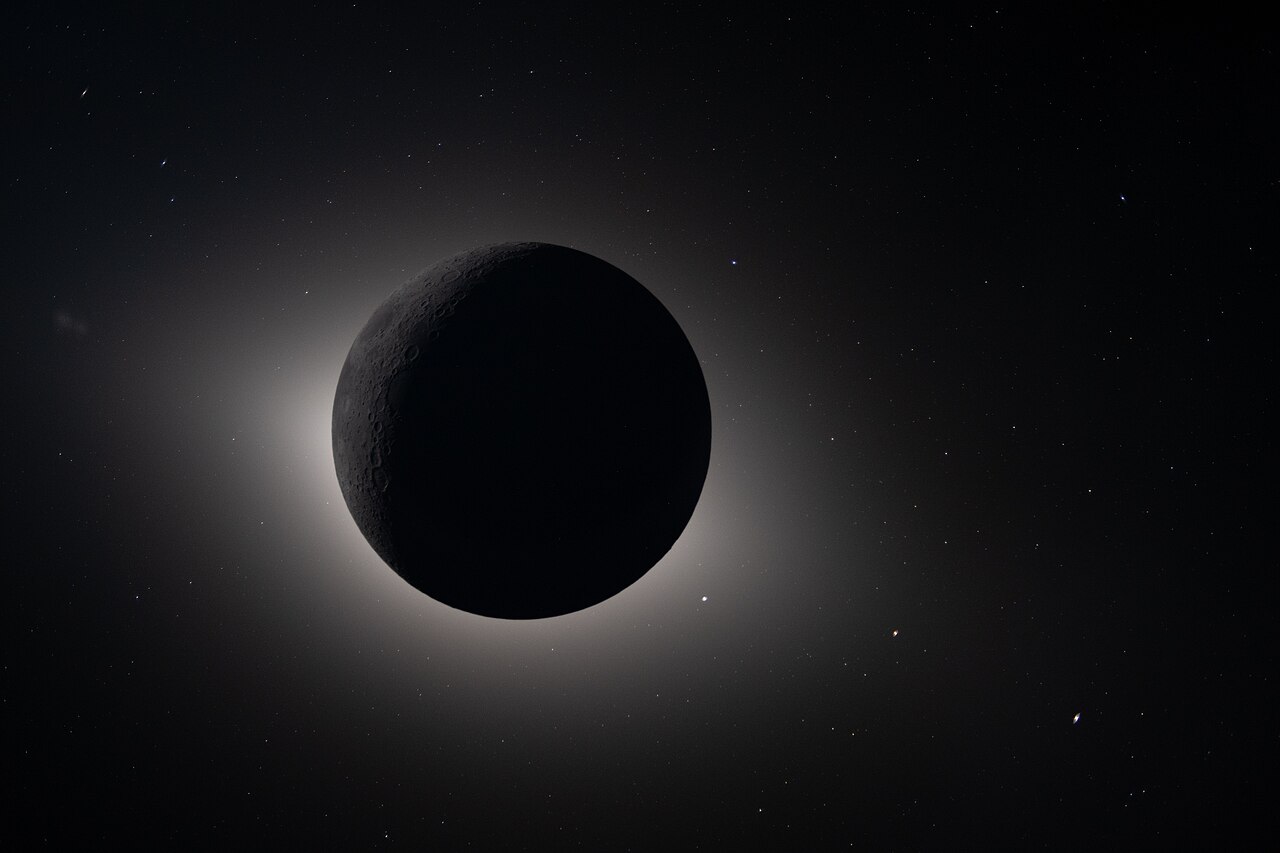
Here is what makes total solar eclipses so special. The Sun is about 400 times wider than the Moon — but it also happens to be about 400 times farther away. The two effects almost exactly cancel out, so the Sun and the Moon appear nearly the same size in our sky.
This is a genuine cosmic fluke. There is no physical law requiring it; it simply happens to be true at this moment in the Earth's history. It is what allows the Moon to cover the Sun's bright disc so precisely during a total eclipse, blotting out the blinding light while revealing the Sun's faint outer atmosphere, the corona, which is otherwise impossible to see. Were the Moon a little smaller or farther away, total eclipses as we know them would not exist.
The two shadows
The Moon's shadow has two parts, and which one you stand in decides what you see.
- The umbra is the dark inner core of the shadow, where the Sun is completely blocked. Only from within this narrow region do you witness a total eclipse.
- The penumbra is the lighter outer shadow, where the Sun is only partly hidden. From here you see a partial eclipse, with a bite taken out of the Sun.
The umbra traces only a thin path across the Earth's surface, often around a hundred kilometres or so wide, sweeping along as the Moon moves. That is why totality is visible from such a small area, while a much larger surrounding region sees a partial eclipse.
The types of eclipse
Not every solar eclipse looks the same, because the alignment and the Moon's distance vary.
- Total eclipse — the Moon completely covers the Sun. Day briefly turns to twilight and the corona appears. This is the show people travel for.
- Partial eclipse — the alignment is imperfect, or you are outside the umbra, so the Moon covers only part of the Sun.
- Annular eclipse — the Moon is near the far point of its slightly oval orbit, so it looks a touch smaller and cannot quite cover the Sun. A brilliant "ring of fire" of sunlight remains around its dark edge.
- Hybrid eclipse — a rare case that shifts between total and annular along its path as the Earth's curvature changes the distance.
The difference between a total and an annular eclipse comes down to the Moon's changing distance, since its orbit is not a perfect circle.
Why not every month?
If a solar eclipse needs the Moon between the Earth and Sun, you might expect one every month at new moon. It does not happen, and the reason is a tilt.
The Moon's orbit is inclined by about five degrees relative to the Earth's path around the Sun. So most months, at new moon, the Moon passes slightly above or below the Sun as seen from Earth, and its shadow sails harmlessly past into space. An eclipse can only occur when the new moon happens to line up at one of the two points where the two orbital planes intersect. This alignment comes around only a few times a year, and a total eclipse over any particular spot is rarer still — which is exactly why they feel like such events. Predicting them is a triumph of the same precise physics that powers GPS, where tiny details of orbits and timing matter enormously.
Watching safely
This is the part to take seriously. Looking directly at the Sun, even when it is mostly covered, can cause permanent eye damage — and because the retina has no pain sensors, you may not feel any harm as it happens. The Sun pours out intense light and ultraviolet radiation, the same radiation our ozone layer normally filters before it reaches us, and staring at the source concentrates that energy onto the eye.
To watch safely:
- Use certified eclipse glasses that meet the proper safety standard, not ordinary sunglasses, which are nowhere near dark enough.
- Try indirect projection, such as a pinhole projector that casts the Sun's image onto a surface, letting you watch without looking up at all.
- During the brief moments of totality only — when the Sun's disc is completely hidden — it is safe to look directly and admire the corona. But you must look away the instant the bright Sun begins to reappear.
The Royal Observatory Greenwich and NASA publish clear safety guidance and forecasts for upcoming eclipses; it is well worth checking before any event.
The bottom line
A solar eclipse happens when the Moon slides directly between the Earth and the Sun and casts its shadow on our planet. Thanks to a striking coincidence — the Sun being about 400 times larger but 400 times farther away than the Moon — the two appear almost the same size, which is why the Moon can perfectly cover the Sun and reveal its glowing corona during totality.
Eclipses are rare from any one place because the Moon's tilted orbit usually carries its shadow past the Earth, and totality falls only along a narrow track. If you ever get the chance to stand in that shadow, take it — but protect your eyes, because the most spectacular sight in the sky is also one that demands respect.
Frequently asked questions
Why doesn't a solar eclipse happen every month at new moon?
The Moon's orbit is tilted by about five degrees relative to the Earth's path around the Sun. Most months the new moon passes slightly above or below the Sun in our sky, so its shadow misses the Earth. An eclipse only happens when the new moon lines up at one of the two points where the orbits cross.
What is the difference between a total and an annular eclipse?
In a total eclipse the Moon completely covers the Sun's disc, briefly turning day to twilight and revealing the Sun's outer atmosphere. In an annular eclipse the Moon is slightly farther from Earth and looks a little smaller, so it leaves a bright 'ring of fire' of sunlight around its edge rather than blocking the Sun entirely.
Is it safe to look at a solar eclipse?
Not with the naked eye. Looking directly at the Sun, even when mostly covered, can permanently damage your eyes without you feeling pain at the time. You must use certified eclipse glasses or safe projection methods. Only during the brief moments of total eclipse, when the Sun's disc is completely hidden, is it safe to look directly, but you must look away again before it reappears.
Why are total solar eclipses so rare from any one place?
The Moon's shadow that produces totality is only a narrow band, often around a hundred or so kilometres wide, sweeping across a small part of the Earth. Any given location falls inside that path only very occasionally, which is why people travel across the world to stand in it.



Join in — free. Comments on Daily Junction are for members, so real names stay rare and bots stay out.
One field. We email you a 6-digit code — no password needed. Your comment is kept while you do it.
Under 13? You’ll need a parent’s OK first — it takes them one click.