

The human eye is often compared to a camera, and for good reason. It gathers light, focuses it, and turns it into an image, all in a sphere little more than two centimetres across. Yet it does this automatically, continuously and in conditions ranging from bright sunshine to near darkness. Understanding how it works reveals one of biology's most elegant pieces of engineering.
What the eye is
The eye is a light-sensing organ that focuses incoming light onto a layer of specialised cells, converts that light into electrical signals, and sends those signals to the brain to be interpreted as vision. It is not a camera in any literal sense, but the comparison is a useful one: both rely on bending light to form a sharp image on a light-sensitive surface.
What we call "seeing" is really a partnership. The eye captures and encodes light; the brain does much of the work of turning those signals into the rich, stable, three-dimensional picture you experience. Vision is as much a brain process as an eye process.
The journey of light through the eye
Light entering your eye passes through several structures in turn, each with a job to do.
- The cornea. This is the clear, curved dome at the very front. It is the eye's main focusing element, doing most of the bending of light. Because it is exposed, it is kept moist and protected by tears and the eyelids.
- The pupil and iris. The pupil is the dark central opening that lets light in. The iris, the coloured ring around it, is a muscle that adjusts the pupil's size, widening it in dim light and shrinking it in bright light, much like the aperture of a camera.
- The lens. Sitting just behind the pupil, the lens fine-tunes the focus. Crucially, it can change shape, becoming rounder to focus on near objects and flatter for distant ones, a process called accommodation.
- The vitreous. Behind the lens, the eye is filled with a clear jelly that helps it keep its round shape and lets light pass through to the back.
By the time light reaches the back of the eye, it has been focused into a sharp, and notably upside-down, image.
The retina: where light becomes a signal
The image lands on the retina, a thin layer of light-sensitive tissue lining the inside back of the eye. This is where the real magic happens, because the retina is packed with cells that turn light into the electrical language of the nervous system.
There are two main types of these light-detecting cells, named after their shapes:
- Rods are extremely sensitive to light and work well in dim conditions. They detect movement and shades of light and dark but do not distinguish colour. This is why, in low light, the world appears in shades of grey.
- Cones work best in brighter light and are responsible for colour vision and sharp detail. Humans typically have three kinds of cone, tuned to roughly red, green and blue light; the brain combines their signals to produce the full range of colours we perceive.
At the centre of the retina is a tiny region called the macula, and within it the fovea, which is densely packed with cones. This is your area of sharpest, most detailed vision. It is why you move your eyes to point this central spot directly at whatever you want to examine closely, such as the words in this sentence.
From eye to brain
The signals generated by the rods and cones are gathered and carried out of the eye along the optic nerve, a thick bundle of around a million nerve fibres. The point where this nerve leaves the retina has no light-detecting cells, which creates a natural blind spot in each eye. You almost never notice it, because your two eyes cover for each other and the brain quietly fills in the gap.
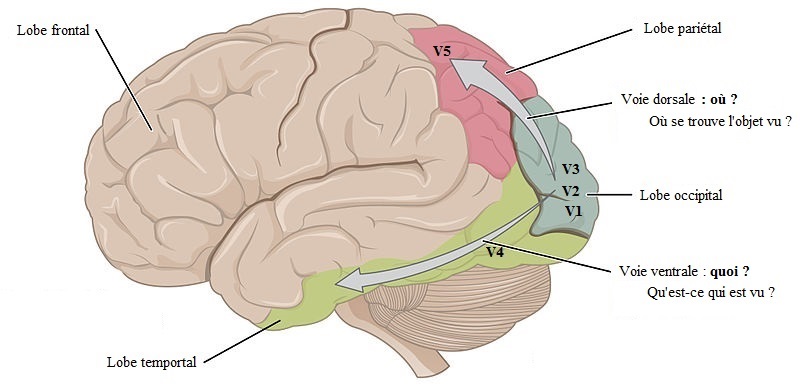
The brain then takes over. It flips the upside-down image the right way up, merges the slightly different views from your two eyes to judge depth and distance, and interprets the flood of signals as meaningful objects, faces and scenes. In a real sense, you see with your brain as much as with your eyes. The eye is part of the wider nervous system, which depends on the same kind of cellular machinery and chemistry found throughout the body and described in our guide to what DNA is.
When focusing goes wrong
Many people's eyes do not focus light perfectly onto the retina, and this is where glasses and contact lenses come in. These conditions are extremely common and are not diseases.
- Short sight (myopia). The eye is slightly too long, or the cornea too curved, so light from distant objects focuses just in front of the retina. Distant things look blurred while close ones stay clear.
- Long sight (hyperopia). The eye is slightly too short, so light focuses behind the retina. Near objects are harder to focus on.
- Astigmatism. The cornea is shaped more like a rugby ball than a football, so light focuses unevenly and vision is blurred at all distances.
- Presbyopia. With age the lens becomes less flexible, making it harder to focus on close objects. This is why many people need reading glasses from their forties onwards.
Corrective lenses simply shift the point of focus back onto the retina. Looking after your eyes with regular sight tests and sensible habits matters too, and our guide to how to care for your eyes covers practical steps. This is general scientific information rather than medical advice; for any concerns about your vision, see an optometrist or your GP.
Light, colour and adaptation
The eye is remarkable at coping with hugely different light levels. Step from bright sunshine into a dark cinema and at first you see almost nothing; minutes later, shapes emerge. This dark adaptation happens as your rods slowly regain full sensitivity and your pupils widen. The reverse, adjusting to sudden brightness, is much faster.
Colour vision, meanwhile, is a brain interpretation of the relative signals from the three cone types. When one cone type is missing or unusual, often through inherited differences, the result is colour vision deficiency, commonly called colour blindness. The physics of how different wavelengths of light produce different colours is the same physics that explains how rainbows form.
The bottom line
The human eye works by focusing light, through the cornea and an adjustable lens, onto the retina, a light-sensitive layer at the back of the eye. There, rod cells handle dim light and motion while cone cells handle colour and fine detail, converting light into electrical signals. Those signals travel along the optic nerve to the brain, which assembles the final image, judges depth and fills in gaps. Common problems such as short and long sight are simply focusing errors, easily corrected with lenses. It is a living camera, but one whose finest work happens not in the eye at all, but in the brain behind it.
Frequently asked questions
How does the eye work in simple terms?
Light from the world enters through the clear front of the eye, is focused by the cornea and lens, and lands on the retina at the back. The retina turns that light into electrical signals, which travel along the optic nerve to the brain, where the image is interpreted.
What is the difference between rods and cones?
Rods and cones are the two main light-detecting cells in the retina. Rods are very sensitive to dim light and detect movement and shades of grey, which is why night vision has little colour. Cones work in brighter light and let you see colour and fine detail.
Why do some people need glasses?
Glasses correct focusing errors. If the eye is slightly too long or the cornea too curved, distant objects focus in front of the retina, causing short sight. If the eye is too short, near objects focus behind it, causing long sight. Lenses shift the focus back onto the retina.
Why can't we see well in the dark straight away?
Moving from light to dark, your rods need time to become fully sensitive again, a process called dark adaptation that can take many minutes. The pupil also widens to let in more light. This is why a dark room slowly becomes easier to see in.



Join in — free. Comments on Daily Junction are for members, so real names stay rare and bots stay out.
One field. We email you a 6-digit code — no password needed. Your comment is kept while you do it.
Under 13? You’ll need a parent’s OK first — it takes them one click.