

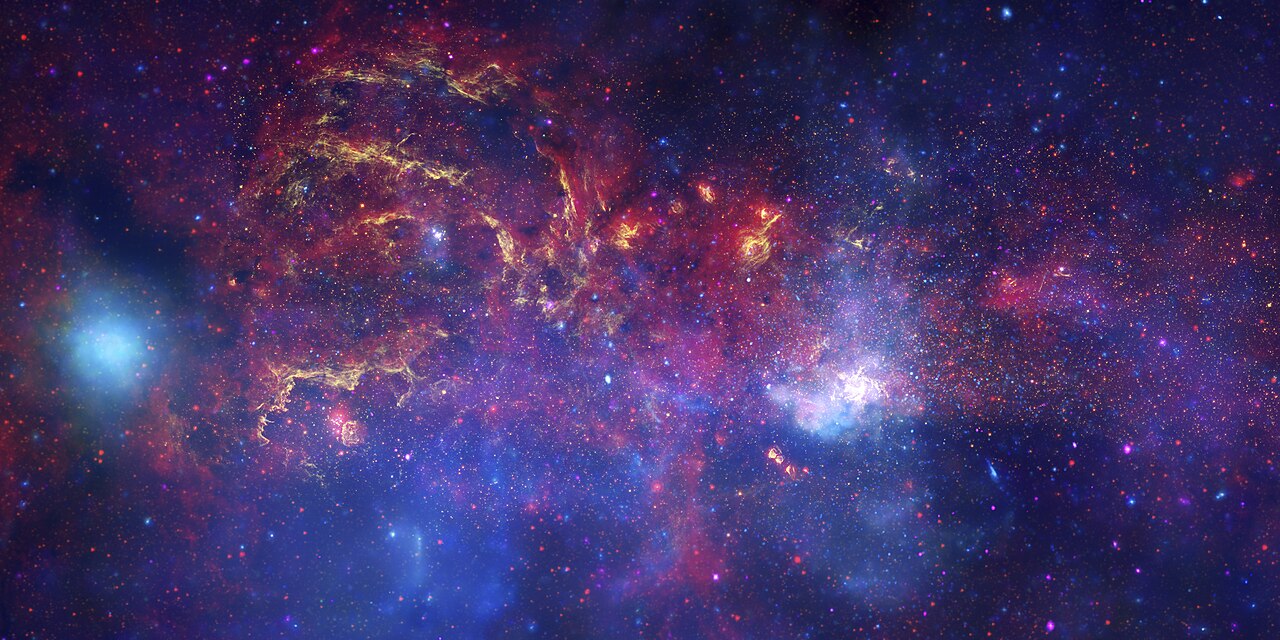
On a clear, dark night, away from city lights, you can sometimes see a faint band of light stretching across the sky. That hazy ribbon is the combined glow of countless stars in our own galaxy, the Milky Way, seen edge-on from the inside. It is a humbling reminder that everything we can see with the naked eye is part of a single, enormous structure, and that this structure is just one of an almost unimaginable number.
What a galaxy is
A galaxy is a vast, gravitationally bound system made up of stars, the gas and dust between them, and a large amount of invisible material called dark matter. Galaxies are the basic building blocks of the universe on the largest scales, the islands in which stars, planets and ultimately life are found.
The scale is hard to grasp. A single galaxy can contain anywhere from a few million stars in the smallest "dwarf" galaxies to many hundreds of billions, even trillions, in the largest. Between the stars lie clouds of gas and dust that serve as the raw material for new stars. And binding it all together is gravity, the same force that keeps a planet in orbit around its star.
What galaxies are made of
A galaxy is far more than just its stars, even though the stars are what we see.
- Stars. These are the luminous balls of gas, like our Sun, that produce light through nuclear reactions in their cores. A galaxy's stars span a huge range of ages, sizes and colours.
- Gas and dust. The space between stars is not empty. It holds vast clouds of hydrogen and helium gas, plus fine dust. These clouds are the nurseries where new stars are born.
- Dark matter. Perhaps the strangest ingredient, dark matter is an unseen form of matter that does not give off light but exerts gravity. Astronomers infer its presence because galaxies rotate faster than their visible matter alone could explain. It is thought to make up most of a galaxy's total mass.
- A central black hole. Most large galaxies, including our own, have a supermassive black hole at their centre, with a mass millions or billions of times that of the Sun.
The main types of galaxy
Galaxies come in several broad shapes, a classification first popularised by the astronomer Edwin Hubble.
| Type | Description |
|---|---|
| Spiral | A flat, rotating disc with curved arms winding out from a bright central bulge |
| Elliptical | A smooth, rounded or egg-shaped cloud of older stars, with little gas or new star formation |
| Irregular | No clear shape, often the result of gravitational interactions or collisions |
Spiral galaxies, like our Milky Way, have graceful arms where bright young stars and star-forming gas are concentrated. Many, again including ours, have a straight bar of stars across the centre and are called barred spirals.
Elliptical galaxies range from nearly spherical to stretched and oval. They tend to contain older, redder stars and relatively little of the gas needed to form new ones. The largest galaxies in the universe are giant ellipticals.
Irregular galaxies lack the orderly structure of the other two, often because they have been pulled out of shape by the gravity of a neighbour.
Our home: the Milky Way
Our own galaxy is the Milky Way, a barred spiral galaxy estimated to contain between 100 and 400 billion stars. Our Sun is just one ordinary star within it, located in a spiral arm roughly two thirds of the way out from the centre.
The Milky Way is so large that light, which travels at about 300,000 kilometres per second, takes around 100,000 years to cross it. Our solar system takes hundreds of millions of years to complete a single orbit around the galactic centre. Understanding scales like these rests on careful, evidence-led measurement, the same approach set out in our guide to the scientific method.
The Milky Way is not alone. It belongs to a small cluster of galaxies called the Local Group, whose largest member is the neighbouring Andromeda galaxy. On still larger scales, galaxies gather into clusters and superclusters, forming a vast cosmic web.
How many galaxies are there?
The honest answer is that nobody knows exactly, but the numbers are staggering. Estimates for the number of galaxies in the observable universe range from a few hundred billion to as many as two trillion. The uncertainty exists because many galaxies are simply too faint or too far away to detect, even with the most powerful telescopes.
Because light takes time to travel, looking far across space also means looking back in time. The most distant galaxies we observe are seen as they were billions of years ago, when the universe was young. Powerful observatories such as the James Webb Space Telescope have pushed this view back to galaxies that formed surprisingly soon after the universe began.
Galaxies are not static
It is tempting to picture galaxies as fixed and unchanging, but they are dynamic. They rotate, they form new stars, and they grow over cosmic time by merging with one another. The Milky Way itself is expected to collide and eventually merge with the Andromeda galaxy in several billion years, long after our Sun's own story has played out, and far beyond the timescales relevant to life on Earth.
The bodies inside galaxies are varied too. Beyond stars and planets there are smaller objects, and learning to tell them apart, as our guide to comets, asteroids and meteors explains, is part of making sense of what a galaxy contains.
The bottom line
A galaxy is an enormous, gravity-bound system of stars, gas, dust and dark matter, the fundamental large-scale structure of the universe. They come mainly in spiral, elliptical and irregular forms, range from millions to trillions of stars, and usually host a supermassive black hole at their heart. We live in the Milky Way, a barred spiral of hundreds of billions of stars, itself just one of perhaps a trillion or more galaxies scattered across the observable universe. Few facts put our place in the cosmos into sharper perspective.
Frequently asked questions
What is a galaxy in simple terms?
A galaxy is a huge collection of stars, along with gas, dust and unseen dark matter, all bound together by gravity. Our Sun is one of hundreds of billions of stars in our own galaxy, the Milky Way.
What is the difference between a galaxy and a solar system?
A solar system is a single star with the planets and other objects orbiting it. A galaxy is far larger, containing many billions of stars, many of which have their own planets. Our solar system is just one tiny part of the Milky Way galaxy.
How many galaxies are there?
Astronomers estimate the observable universe contains somewhere from a few hundred billion to perhaps two trillion galaxies. The exact number is uncertain because many are too faint or distant to detect with current telescopes.
What galaxy do we live in?
We live in the Milky Way, a barred spiral galaxy containing an estimated 100 to 400 billion stars. Our Sun sits in one of its spiral arms, roughly two thirds of the way out from the centre.



Join in — free. Comments on Daily Junction are for members, so real names stay rare and bots stay out.
One field. We email you a 6-digit code — no password needed. Your comment is kept while you do it.
Under 13? You’ll need a parent’s OK first — it takes them one click.