

The word "radioactive" tends to conjure images of glowing green sludge, disaster movies and warning symbols. Yet radioactivity is a perfectly natural process happening all around you right now — in the rocks beneath your feet, in the food you eat, even inside your own body. It is also one of the most useful phenomena in modern science and medicine. Stripped of the drama, the underlying idea is surprisingly elegant. This guide explains what radioactivity really is.
What it is
Radioactivity is the process by which an unstable atomic nucleus releases energy in the form of radiation, in order to become more stable. To understand it, picture the structure of an atom: a dense central nucleus, made of particles called protons and neutrons, surrounded by even smaller electrons.
In most atoms, that nucleus is stable and stays as it is indefinitely. But in some, the balance of protons and neutrons is unstable. Such a nucleus will, at some unpredictable moment, shed energy — and often particles too — to settle into a more stable form. That release is radiation, and an atom that does this is described as radioactive. The process is called radioactive decay.
A striking feature is that this is fundamentally random. We cannot predict when any single atom will decay, yet across billions of atoms the behaviour is wonderfully predictable, which is what makes it measurable and useful.
The three types of radiation
Not all radiation is the same. There are three main types from radioactive decay, and they differ dramatically in how far they travel and what can stop them.
| Type | What it is | Stopped by |
|---|---|---|
| Alpha | A heavy particle (two protons, two neutrons) | A sheet of paper or skin |
| Beta | A fast-moving electron | A thin sheet of metal, e.g. aluminium |
| Gamma | A burst of high-energy electromagnetic waves | Thick lead or concrete |
- Alpha radiation is the most massive but the least penetrating. It cannot pass through skin, but it is harmful if a source is swallowed or inhaled, getting inside the body.
- Beta radiation is lighter and more penetrating than alpha, passing through paper but blocked by a few millimetres of metal.
- Gamma radiation is not a particle at all but pure energy, similar in nature to light and X-rays. It is highly penetrating and requires dense shielding such as lead.
This is why understanding the type of radiation matters so much: a source that is harmless at arm's length can be dangerous if it enters the body, and vice versa.
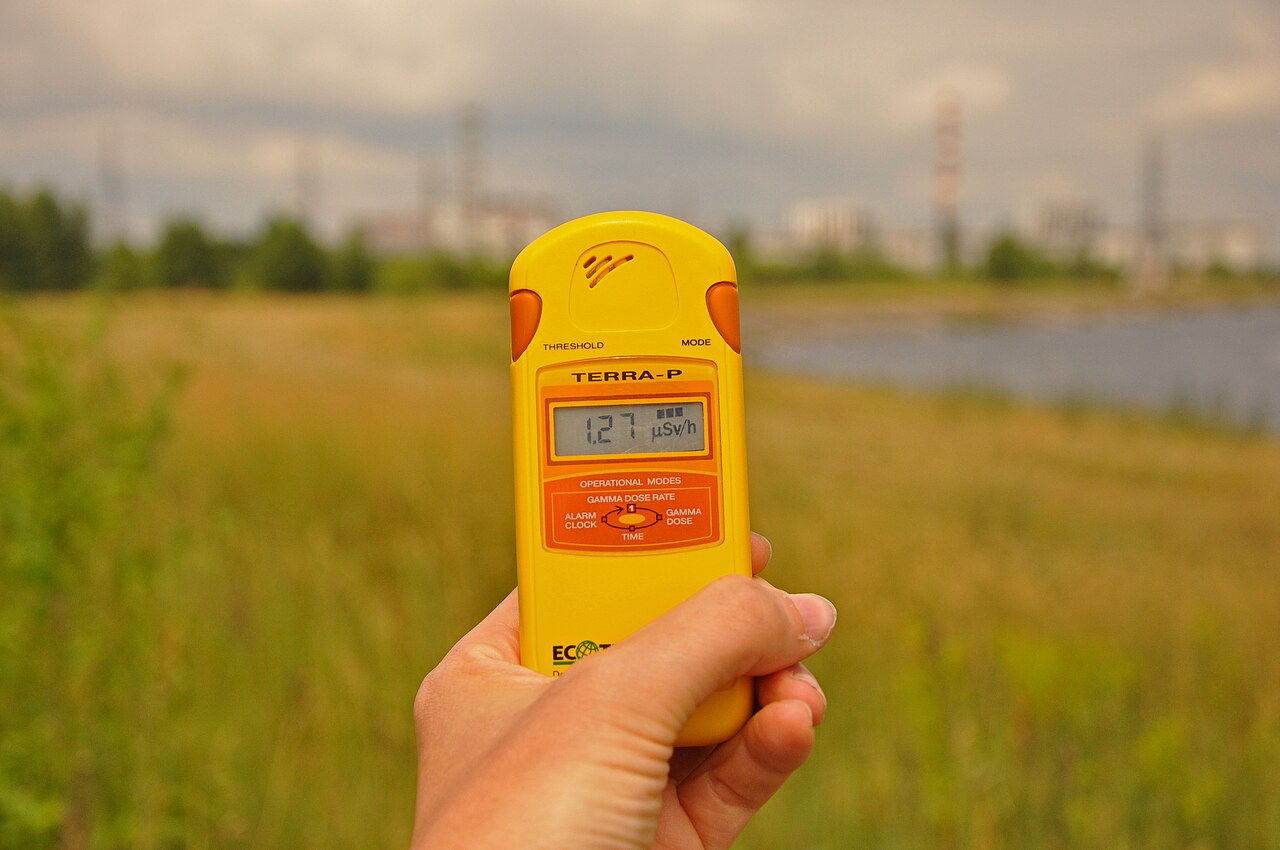
Half-life: nature's clock
Because decay is random for individual atoms but predictable in bulk, scientists describe radioactive materials using half-life: the time it takes for half of the atoms in a sample to decay.
The pattern is steady and repeating. Start with a sample, and after one half-life, half remains. After two half-lives, a quarter remains. After three, an eighth, and so on. The material never quite vanishes, but it dwindles in a precise, mathematical way.
What makes this remarkable is the range. Half-lives span from tiny fractions of a second to billions of years. Some medical isotopes decay within hours, which is convenient because they do not linger in the body. Others, like certain forms of uranium, have half-lives measured in billions of years — older than the Earth itself. This predictability is why half-life can act as a clock, a point we return to below.
Where radioactivity comes from
A common surprise is just how natural and widespread radioactivity is. We live in a constant, low level of it known as background radiation, which comes from several sources:
- Rocks and soil. Many natural minerals contain trace radioactive elements; granite, for instance, is mildly radioactive, and radon gas seeps from the ground in some areas.
- Cosmic rays. High-energy radiation from space rains down constantly, so we receive a little more at altitude, such as on aeroplanes.
- Food and our bodies. Foods like bananas and Brazil nuts contain naturally radioactive potassium, and our own bodies are very slightly radioactive as a result.
For the vast majority of people, this background level is harmless; our bodies have always lived with it. The phenomenon is studied with the same evidence-led care described in the scientific method, so that genuine risks can be separated from imagined ones.
Why it is useful
Far from being only a hazard, radioactivity is put to extraordinary use:
- Medicine. Radiation is used to image the body, diagnose disease and treat cancers by targeting harmful cells. Short-lived isotopes are especially valuable here.
- Power. Nuclear power stations harness the energy released when certain heavy atoms split, generating large amounts of low-carbon electricity — one strand of the wider mix discussed in renewable and low-carbon energy.
- Dating the past. Because half-lives are so reliable, scientists measure the decay of elements like carbon-14 to date ancient objects, fossils and rocks, sometimes over millions of years.
- Industry. Radiation is used to check welds, sterilise medical equipment and gauge thicknesses in manufacturing.
The same property that makes radiation dangerous at high doses — its ability to penetrate matter and affect cells — is exactly what makes it so powerful as a tool when carefully controlled.
Why it can be dangerous
The risk from radioactivity comes down to dose. Radiation carries enough energy to knock electrons from atoms, which is why it is called ionising radiation. In living tissue, this can damage cells and the DNA inside them.
At the low levels of natural background radiation, the body copes easily. At high doses, the damage can cause radiation sickness in the short term and raise the risk of cancer in the long term. This is why those who work with radiation follow strict limits, use shielding, and keep their distance and exposure time to a minimum. The guiding principle is keeping doses as low as reasonably achievable.
This is general scientific information, not safety or medical advice. For concerns about radon in the home or occupational exposure, consult the relevant health authority such as the UK Health Security Agency.
The bottom line
Radioactivity is the natural process by which unstable atomic nuclei shed energy as radiation to become stable. That radiation comes in three main types — alpha, beta and gamma — which differ sharply in how far they travel and what stops them. Half-life describes how quickly a material decays, from fractions of a second to billions of years, and acts as a reliable natural clock. Radioactivity surrounds us harmlessly as background radiation, powers vital uses in medicine, energy and dating the past, yet becomes dangerous at high doses. Understood properly, it is not the stuff of horror films but one of nature's most useful and revealing phenomena.
Frequently asked questions
What is radioactivity in simple terms?
Radioactivity is what happens when the centre of an atom, called the nucleus, is unstable and gives off energy in the form of radiation to settle into a more stable state. This release happens entirely on its own, at random for any single atom, and is a natural process that has been going on since the universe formed.
What are the three types of radiation?
They are alpha, beta and gamma. Alpha radiation is the heaviest and least penetrating, stopped by a sheet of paper or skin. Beta radiation is lighter and passes through paper but is stopped by a thin sheet of metal. Gamma radiation is pure energy, highly penetrating, and needs thick lead or concrete to block it.
What is a half-life?
A half-life is the time it takes for half of the radioactive atoms in a sample to decay. After one half-life, half remain; after two, a quarter; and so on. Half-lives vary enormously, from tiny fractions of a second to billions of years, which is why some radioactive materials are short-lived and others persist for ages.
Is radioactivity always dangerous?
No. Low levels of natural radiation are all around us, in rocks, soil, food and from space, and our bodies cope with this background exposure. The danger comes from high doses, which can damage living cells and DNA. Whether radiation is harmful depends on the type, the dose and how long you are exposed.



Join in — free. Comments on Daily Junction are for members, so real names stay rare and bots stay out.
One field. We email you a 6-digit code — no password needed. Your comment is kept while you do it.
Under 13? You’ll need a parent’s OK first — it takes them one click.