

Britain is rarely short of ambition when it comes to technology. Ministers speak of a "quantum revolution", funding announcements arrive with clockwork regularity, and barely a month passes without a university issuing a press release about a record-breaking qubit count. Yet for all the noise, the genuine story of UK quantum computing is quieter, more technical, and considerably more interesting than the headlines suggest.
The country is genuinely competitive. That is not government spin — it is the assessment of researchers, investors, and competitors in the United States, Germany, and China who watch the British ecosystem with considerable attention. But understanding where the real progress is happening requires looking past the strategy documents and into the laboratories, the spin-out companies, and the procurement decisions that rarely make the front pages.
What the Government's £2.5 Billion Actually Buys
The National Quantum Strategy, published in 2023 and running to 2033, commits £2.5 billion of public money to the sector. It is a serious sum, though context matters: the United States has authorised more than $1.8 billion through its National Quantum Initiative alone, and China's state investment figures are notoriously difficult to verify but almost certainly larger still.
What the UK funding does exceptionally well is seed infrastructure that would otherwise take decades to build commercially. The Quantum Computing and Simulation Hub, led by Oxford University and involving more than 50 partner organisations, has trained several hundred quantum-ready researchers who have since dispersed across industry. The National Physical Laboratory in Teddington has become a first-rate centre for quantum metrology — the precise measurement science that underpins everything from quantum clocks to sensor networks. These are not glamorous projects, but they constitute the bedrock on which commercial applications will eventually rest.
The criticism levelled by some in the sector is that public funding has historically favoured academic publication over commercialisation. That balance is shifting. Innovate UK has become more aggressive in backing early-stage companies with real hardware, and the defence procurement machine — through DSTL and the broader Ministry of Defence supply chain — has begun writing serious contracts that give startups the revenue certainty they need to scale.
The Hardware Race: Where British Firms Are Genuinely Competitive
Quantum computing hardware is not a single technology. It is a collection of competing approaches — superconducting qubits, trapped ions, photonics, silicon spin qubits, neutral atoms — each with distinct advantages and drawbacks, and none yet clearly dominant. This fragmentation is, counterintuitively, good news for smaller nations. The United States, with IBM and Google pursuing superconducting qubits at vast scale, has effectively cornered one segment. The UK has made a credible bet on trapped-ion technology, and that bet is paying off.
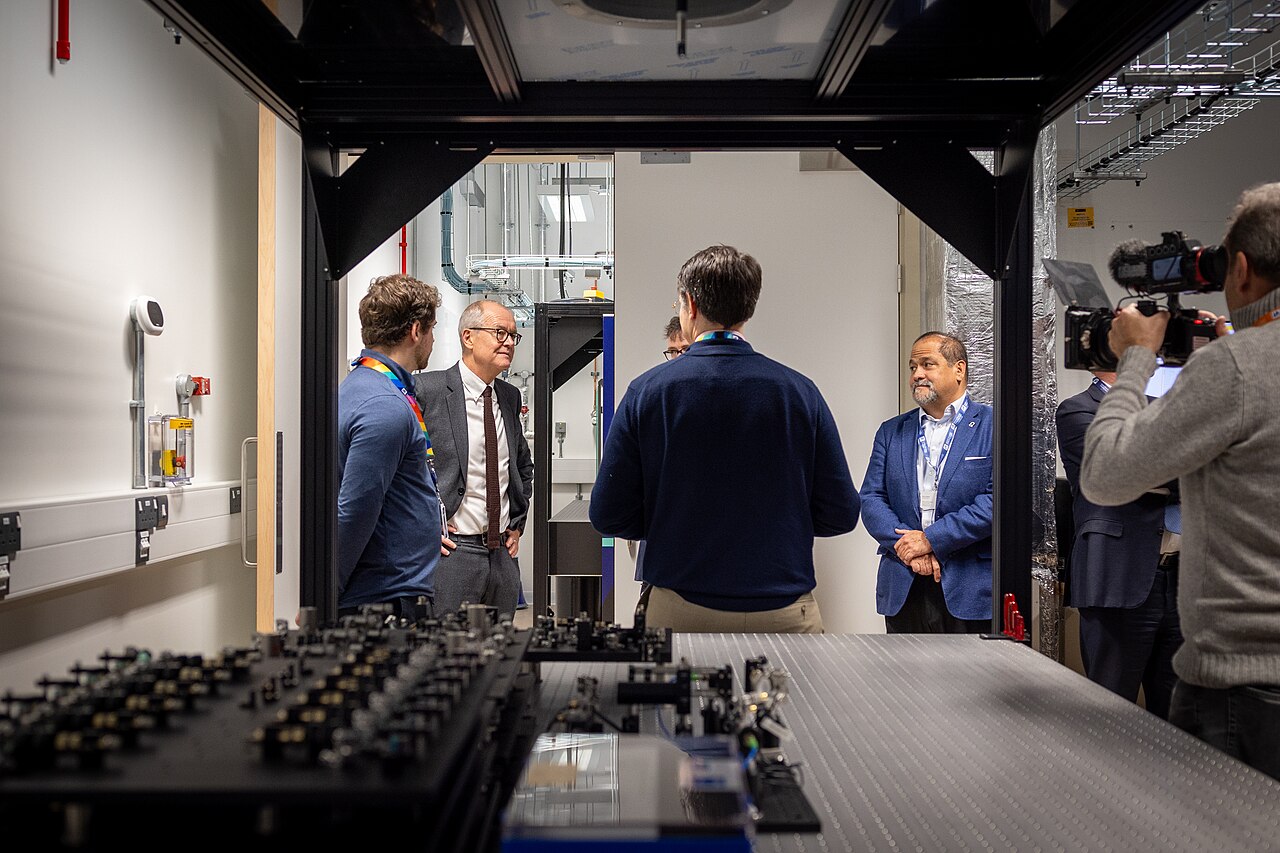
Quantinuum, formed from the merger of Cambridge Quantum Computing and Honeywell Quantum Solutions, operates its primary research presence in Cambridge. Its H-series quantum computers have consistently achieved the highest recorded quantum volume — a composite measure of qubit count, connectivity, and error rates — of any commercially available system. In 2023 the company demonstrated a breakthrough in quantum error correction published in Nature, a paper widely regarded as one of the most significant experimental results in the field that year.
Oxford Ionics, a spin-out from the University of Oxford, is taking a different approach: embedding its trapped-ion processor architecture into standard semiconductor chips, which could dramatically reduce manufacturing costs and enable scale that all-custom hardware cannot achieve. The company is deliberately low-profile, but people who have seen its benchmarking data speak of it in notably elevated terms.
Riverlane, based in Cambridge, is not building quantum processors at all. It is building the quantum error correction software stack — the operating system layer, in effect, that will be required to make any of the hardware above useful. Its work has attracted backing from Amadeus Capital Partners and a growing list of hardware vendors who recognise that error correction is the decisive unsolved problem standing between today's noisy intermediate-scale quantum machines and genuinely useful computation.
The Applications Arriving Before the Headlines Expect
Public discussion of quantum computing tends to oscillate between two poles: the threat to encryption and the promise of infinite computational power. Both framings mislead. The encryption threat is real but distant, and already being addressed through post-quantum cryptography standards. The infinite power framing is simply wrong — quantum computers will be extraordinarily useful for specific problem classes and irrelevant to most of what classical computers do today.
The applications closest to commercial readiness sit in three areas. First, molecular simulation for drug discovery and materials science: quantum computers can natively model quantum mechanical systems in ways that require exponential resources on classical hardware. Several UK pharmaceutical companies are already running early exploratory programmes with quantum hardware providers. Second, optimisation problems in logistics and finance, where finding near-optimal solutions across enormous combinatorial search spaces is economically valuable. Third, quantum sensing, which is arguably the nearest-term market: quantum-enhanced sensors for gravity mapping, navigation, and medical imaging are approaching commercial deployment without requiring the full error-corrected quantum computer that headlines fixate upon.
The NHS has a quiet but growing interest in quantum sensing for brain imaging applications. Cerca Magnetics, a spin-out from the University of Nottingham, has developed an optically pumped magnetometer system for magnetoencephalography — brain scanning — that is lighter, cheaper, and potentially more accessible than existing superconducting alternatives. It will not compute drug interactions or break encryption. It will help neurologists in a way that matters immediately.
Talent, Retention, and the Silicon Valley Problem
Every honest conversation about the UK quantum ecosystem eventually arrives at the same anxiety: talent retention. Britain trains exceptional quantum scientists. It does not always keep them.
The draw of American salaries and the sheer scale of investment available to startups in the Bay Area and Boston remains powerful. Several researchers who trained at Oxford or Cambridge quantum centres now work for Google, IBM, or well-funded US startups. This is not a crisis unique to quantum — it is a structural feature of the global scientific labour market — but it is acute in a field where the expert community worldwide numbers only in the thousands.
The countervailing forces are strengthening. Quantinuum, Riverlane, and Oxford Ionics are paying competitive salaries by UK standards, and the clustering of talent around Cambridge and Oxford creates genuine network effects that make the UK attractive in its own right. The government's high-skilled visa reforms have also made it easier to recruit internationally. A researcher from the United States, Japan, or the Netherlands considering a move to a European quantum hub is increasingly likely to consider London or Cambridge alongside Munich or Amsterdam.
Britain will not win the quantum computing race by outspending the United States or China. It will remain competitive by being unusually good at specific things: ion trap hardware, error correction software, quantum sensing, and the translation of fundamental physics into engineering. That is a narrower ambition than the strategy documents imply, but it is a realistic and commercially valuable one. The real progress is happening in exactly those places — quietly, seriously, and without much ceremony.
Frequently asked questions
When will quantum computers be useful in everyday business in the UK?
Most experts project that narrow quantum advantage on specific commercial tasks — such as drug discovery simulation or supply-chain optimisation — is realistic within three to five years. General-purpose quantum computing that replaces classical machines for ordinary tasks remains a decade or more away.
Does quantum computing threaten current encryption and online security?
A sufficiently powerful quantum machine could in theory break widely used public-key encryption, but that scale of hardware does not yet exist. The UK's National Cyber Security Centre is already overseeing migration to post-quantum cryptographic standards, giving organisations time to prepare.
Which UK universities are leading quantum research?
Oxford, Cambridge, Bristol, and Imperial College London are consistently ranked among the world's top quantum research institutions. The government-backed Quantum Computing and Simulation Hub, led by Oxford, coordinates much of the national academic effort.
Sources
- UK National Quantum Strategy — Department for Science, Innovation and Technology
- Quantinuum achieves quantum error correction milestone — Nature
- Oxford Ionics raises Series A to advance quantum processor technology — Financial Times
- UK Quantum Computing and Simulation Hub
- NCSC guidance on post-quantum cryptography migration



Join in — free. Comments on Daily Junction are for members, so real names stay rare and bots stay out.
One field. We email you a 6-digit code — no password needed. Your comment is kept while you do it.
Under 13? You’ll need a parent’s OK first — it takes them one click.