
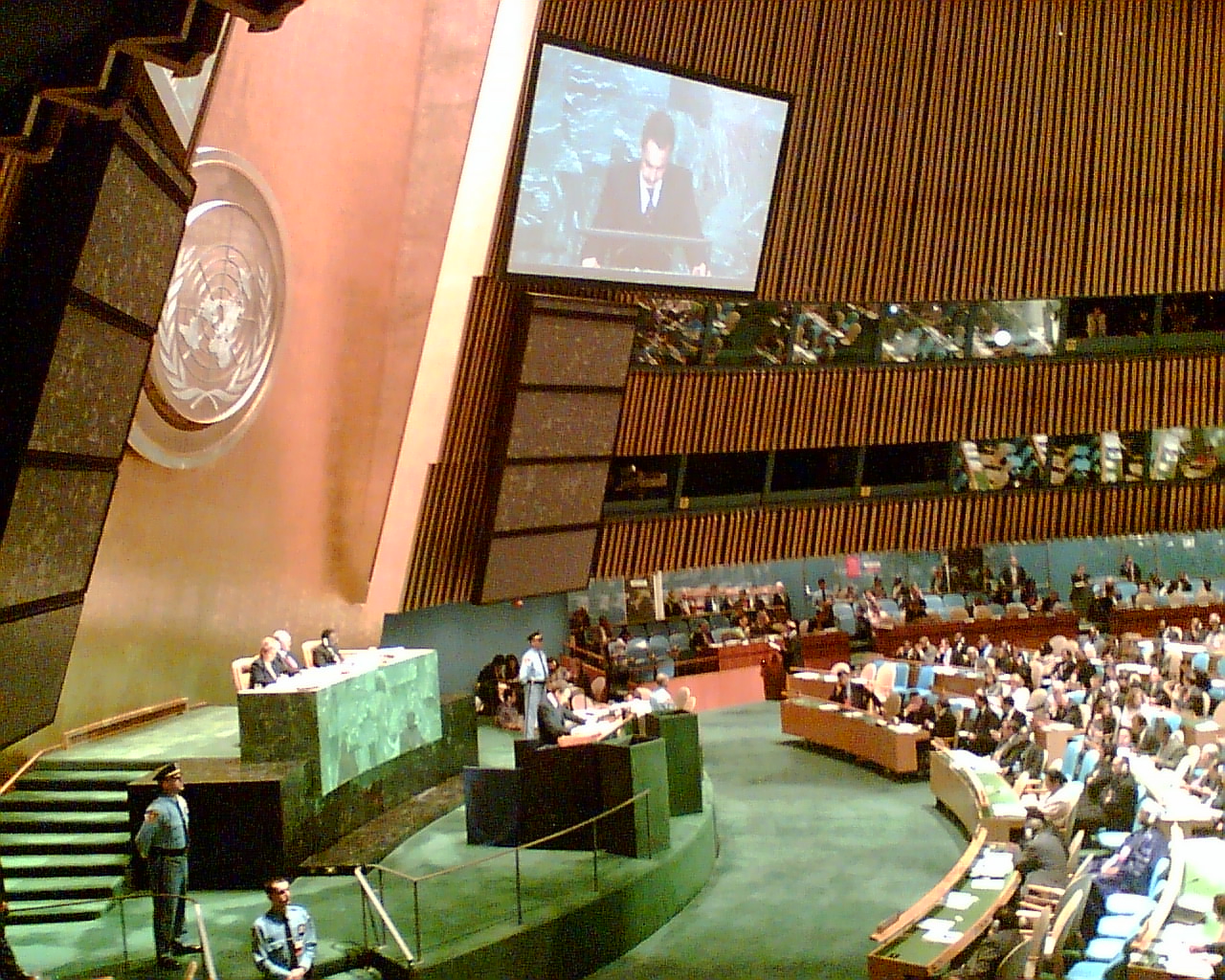
The United Nations Security Council can authorise military force, impose binding sanctions and refer situations to the International Criminal Court — powers no other international body holds. It can also be stopped dead by a single raised hand. Under Article 27 of the UN Charter, a substantive resolution needs nine votes out of fifteen, and among those nine must be the concurring votes of the five permanent members: Britain, France, the United States, Russia and China. One negative vote from any of them kills the text, however the other fourteen members vote. That is the veto, and it was never an accident or an oversight. It was the entry fee.
At the San Francisco conference in 1945, the smaller states objected loudly to the formula the great powers had agreed at Yalta a few months earlier. The answer they received was blunt: without the veto there would be no Charter, because neither the United States Senate nor the Soviet Union would join an organisation that could order them about. The League of Nations had collapsed partly because the powers that mattered either never joined or walked out. The veto was the mechanism for keeping them inside the tent — a deliberate trade of equality for participation. A Council that could, in theory, coerce a great power would in practice have no great powers in it.
The rule has been softened at the edges by practice rather than text. Article 27 says "concurring votes", which read literally would make an abstention a veto; from 1946 onwards the Council treated abstention as acquiescence, and the International Court of Justice blessed that reading in its 1971 Namibia opinion. Procedural questions — the agenda, inviting a speaker — need only nine votes with no veto at all, which is how the Council keeps talking about subjects a permanent member would rather bury. The General Assembly's Uniting for Peace resolution of 1950 lets it recommend collective measures when the Council is deadlocked, and since Liechtenstein's initiative was adopted in 2022, every veto cast automatically triggers an Assembly debate within ten working days in which the vetoing state is expected to explain itself. Explanation, though, is the limit: none of these devices overrides the veto on a binding decision.
Usage tells its own story. The Soviet Union and then Russia have cast vetoes far more often than any other member — well over a hundred and counting, most recently to shield its position over Ukraine and Syria. The United States has relied on it chiefly on resolutions concerning Israel. Britain has not used its veto alone since 1989, over Panama, and France not since 1976; both now argue publicly for restraint, which costs little when neither intends to wield the power anyway.
Why every reform road leads back to the P5
The lock is written into Article 108. Amending the Charter requires a two-thirds vote of the General Assembly and then ratification by two thirds of all UN members — including every permanent member. The five therefore hold a veto over any attempt to abolish, dilute or share the veto. A state asked to ratify the removal of its own most valuable diplomatic asset will decline, and there is no legal route around its refusal. The one amendment ever made to the Council's composition, in 1965, enlarged it from eleven to fifteen by adding four elected seats; it passed precisely because it redistributed nothing that the P5 valued.
The rival reform camps then finish the job of paralysis themselves. The G4 — Brazil, Germany, India and Japan — seek permanent seats of their own; the Uniting for Consensus group, led by Italy and Pakistan, opposes any new permanent members because the candidates are their regional rivals; the African Union's Ezulwini Consensus demands two permanent African seats with full veto rights, which northern governments will not concede. China resists a Japanese seat, Russia has little appetite for any dilution, and the United States offers warm words for India while opposing extension of the veto to anyone. Each bloc can block the others' preferred model in the Assembly long before Article 108 is even reached.

Softer proposals — the French-Mexican pledge to forgo the veto in mass-atrocity situations, the ACT group's code of conduct signed by more than 120 states — bind only volunteers, and the members most likely to cast vetoes have signed neither. The design of 1945 thus performs exactly as intended: it keeps the great powers at the table by guaranteeing that the table can never be turned on them.



Join in — free. Comments on Daily Junction are for members, so real names stay rare and bots stay out.
One field. We email you a 6-digit code — no password needed. Your comment is kept while you do it.
Under 13? You’ll need a parent’s OK first — it takes them one click.