
Context: from niche to national infrastructure
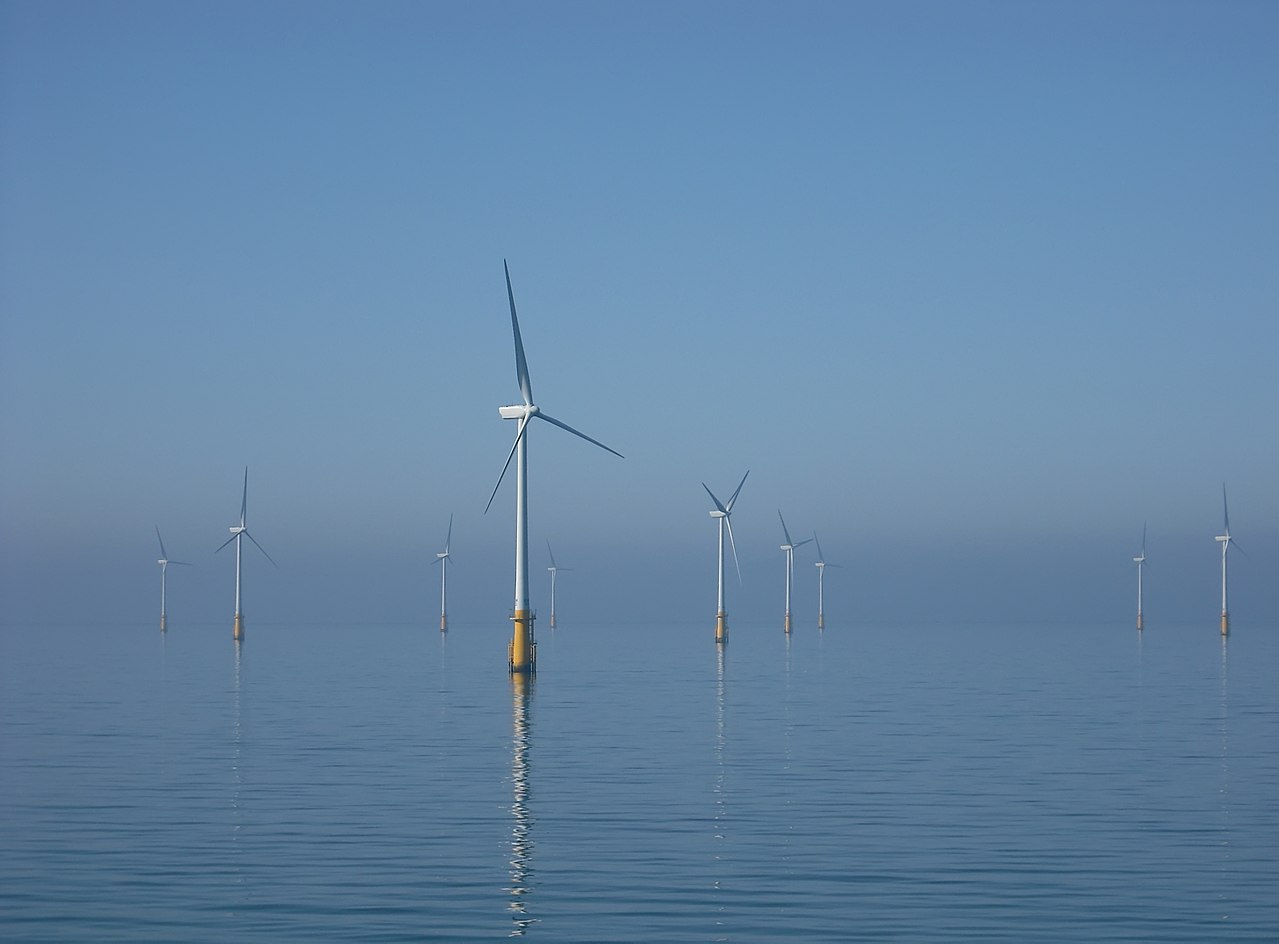
Offshore wind has transformed from a niche technology to the backbone of the UK's electricity system in less than two decades. The first commercial offshore wind farm, North Hoyle off the coast of Wales, began operating in 2003 with a capacity of just 60 MW. By January 2026, the UK has 16.8 GW of operational offshore wind capacity across 52 wind farms, making it the global leader by a significant margin. Offshore wind now generates more electricity than coal, nuclear or onshore wind, and in 2025 it provided 28% of the UK's total electricity generation, up from 24% in 2024 and just 10% in 2020.
This expansion has been driven by a combination of falling costs, strong policy support and the UK's natural advantages. The levelised cost of offshore wind—the total cost of building and operating a wind farm divided by the electricity it generates over its lifetime—has fallen by 70% since 2015, making it one of the cheapest sources of new electricity. The government's Contracts for Difference (CfD) scheme, which guarantees a minimum price for renewable electricity, has provided the revenue certainty needed to attract billions in investment. And the UK's shallow coastal waters, particularly in the North Sea, offer some of the best wind resources in the world.
But the success story is now hitting hard limits. The grid cannot absorb new capacity fast enough, leading to costly curtailment. Supply chains are stretched, with global competition for turbines, cables and installation vessels driving up costs and delaying projects. Planning for onshore transmission infrastructure—the cables and substations needed to connect offshore wind farms to the grid—faces fierce local opposition and regulatory delays. And the government's target of 50 GW by 2030, announced in 2022, requires adding 6-7 GW per year, double the rate achieved in 2025. Without urgent action, the UK risks squandering its lead and missing its net zero targets.
The data: where offshore wind stands in 2026
As of January 2026, the UK has 16.8 GW of operational offshore wind capacity, according to RenewableUK's UK Wind Energy Database. This represents an increase of 2.1 GW from January 2025, when capacity stood at 14.7 GW. The growth came from 12 new projects commissioned in 2025, the largest being Dogger Bank A (1.2 GW) off the Yorkshire coast, the world's biggest offshore wind farm, which began generating in March 2025.
The 16.8 GW is spread across 52 wind farms, from small early projects like Barrow (90 MW, operational since 2006) to giants like Hornsea Two (1.4 GW, completed in 2022). The largest concentration is in the North Sea, which hosts 70% of UK capacity, followed by the Irish Sea (20%) and the Atlantic approaches off Scotland (10%). Scotland accounts for 30% of total capacity, England 65%, and Wales 5%.
Offshore wind generated 78 TWh of electricity in 2025, up from 67 TWh in 2024, making it the second-largest source after gas (95 TWh) and ahead of nuclear (45 TWh). It provided 28% of total UK electricity generation in 2025, and on particularly windy days it has supplied over 60% of demand. The capacity factor—the ratio of actual output to maximum possible output—averaged 48% in 2025, up from 42% in 2020, reflecting larger turbines and better siting.

What's changing: the 50 GW target and the barriers ahead
The government's target, set in the 2022 British Energy Security Strategy and reaffirmed in the 2023 Powering Up Britain plan, is to reach 50 GW of offshore wind capacity by 2030, with 5 GW of that from floating wind. This would make offshore wind the UK's largest electricity source, capable of powering every home in the country. Achieving it requires adding 33 GW in four years, or 6-7 GW per year—more than double the 3 GW annual average achieved in 2023-2025.
The pipeline is theoretically sufficient. RenewableUK's database lists 35 GW of offshore wind projects under construction or with planning consent, plus another 40 GW in earlier stages of development. But the gap between consented capacity and operational capacity is widening, not closing, due to three critical bottlenecks.
Grid connection delays
The biggest barrier is the grid. National Grid's transmission network, built for large centralised power stations, is not designed to absorb electricity from dozens of wind farms scattered around the coast. Connecting a new offshore wind farm requires building offshore cables to bring power ashore, onshore cables to connect to the nearest substation, and often upgrades to the substation and wider network to handle the extra capacity. The planning and construction of this infrastructure takes 5-10 years, far longer than building the wind farm itself.
As a result, the grid connection queue has ballooned. National Grid ESO's 2025 Electricity Ten Year Statement reported that 23 GW of offshore wind projects are waiting for grid connections, with some facing delays of 3-5 years. Projects that received planning consent in 2022 are now being told they cannot connect until 2027 or 2028. This delay adds costs—developers must continue paying for project management and financing without generating revenue—and creates uncertainty that deters investment.
The consequences are already visible in curtailment costs. When the grid cannot absorb all the electricity from wind farms, it pays them to switch off. Under CfD contracts, wind farms receive compensation for lost revenue when curtailed. In 2025, curtailment cost an estimated £800 million, up from £215 million in 2023, according to analysis by Imperial College London. This cost is passed to consumers through energy bills, adding roughly £25 per household per year.
Supply chain constraints
The second bottleneck is the supply chain. Offshore wind requires massive turbines (the latest models have 15 MW capacity and 260-metre rotor diameters), hundreds of kilometres of subsea cables, and specialised installation vessels. Global demand for these components has surged as countries race to expand offshore wind, but supply has not kept pace. Lead times for turbines have stretched from 18 months to 3 years, and the cost of key materials—steel, copper, rare earth magnets—has risen sharply due to inflation and geopolitical disruption.
The UK has a strong domestic supply chain in ports (Hull, Teesside, the Humber) and manufacturing (blade factories in the Isle of Wight and Hull), but it relies on imports for most turbines and cables. Siemens Gamesa, Vestas and GE dominate turbine supply, and all three have faced production delays and quality issues in 2024-2025. The shortage of installation vessels is particularly acute: there are only around 30 suitable vessels globally, and they are booked years in advance. UK projects increasingly compete with European and Asian developments for the same resources, driving up costs.
Planning and local opposition
The third barrier is planning, particularly for onshore transmission infrastructure. Offshore wind farms are consented through the Marine Management Organisation and face relatively little opposition, but the onshore cables and substations needed to connect them to the grid require planning permission from local authorities and face fierce resistance. Communities in East Anglia, Lincolnshire and Yorkshire have mounted campaigns against "pylon blight," arguing that new overhead transmission lines damage landscapes and property values.
The government has responded by pushing for more underground and subsea cables, but these are far more expensive—up to 10 times the cost of overhead lines—and still face objections. The Planning Inspectorate's backlog of transmission infrastructure cases has grown, with some decisions taking 2-3 years. In 2025, two major offshore wind projects—Norfolk Boreas (1.4 GW) and East Anglia Three (1.4 GW)—saw their grid connection plans rejected by local councils, forcing developers to redesign and resubmit, adding 18-24 months to timelines.
What it means: can the UK hit 50 GW by 2030?
The consensus among industry analysts is that 50 GW by 2030 is technically achievable but increasingly unlikely without major policy intervention. Cornwall Insight, an energy consultancy, forecasts 42-45 GW by 2030 under current policies, while Aurora Energy Research puts it at 40-43 GW. RenewableUK, the industry trade body, maintains that 50 GW is possible if the government acts urgently on grid, planning and supply chain support.
The government has taken some steps. In 2024, it launched the Electricity Networks Commissioner to accelerate grid connections and simplify planning for transmission. The 2025 Budget allocated £3 billion for grid upgrades, and National Grid has committed to reducing connection queue times from 5 years to 2 years by 2027. The Crown Estate's latest seabed leasing round, announced in January 2026, allocated sites for 8 GW of new capacity, with simplified environmental assessments and grid connection pathways.
But these measures are incremental, not transformational. Industry groups argue that hitting 50 GW requires a step-change: giving transmission infrastructure the same planning priority as offshore wind farms, creating a strategic reserve of installation vessels and turbines, and providing stronger financial support for projects hit by cost inflation. The government's Offshore Wind Sector Deal, signed in 2019, committed to 30 GW by 2030—a target already exceeded—but has not been updated to reflect the 50 GW ambition.
What to watch next
Watch National Grid's connection queue updates, published quarterly, for signs that delays are shrinking. Watch the outcomes of the Crown Estate's 2026 leasing round: if developers bid aggressively despite cost pressures, it signals confidence in the 50 GW target; if bids are cautious or projects are delayed, it suggests the target is slipping. Watch the government's response to the Electricity Networks Commissioner's recommendations, expected in spring 2026, which will set the framework for grid investment and planning reform.
And watch the CfD auction results. The next allocation round is scheduled for autumn 2026, and the strike prices—the guaranteed price per MWh that developers bid—will reveal whether offshore wind remains competitive or whether cost inflation is eroding its advantage. If strike prices rise sharply, it could slow the pipeline and make the 50 GW target unaffordable. If they stay low, it will confirm that offshore wind is still the cheapest route to net zero, and the UK's lead is secure.
Offshore wind is the UK's greatest climate success story, but it is at a critical juncture. The next four years will determine whether the 50 GW target is met, missed narrowly, or abandoned—and whether the UK remains the global leader or is overtaken by countries moving faster on grid, planning and supply chain support. The technology works, the resources are there, and the pipeline is full. What's missing is the infrastructure and policy framework to turn potential into reality.
Frequently asked questions
Why is the UK so far ahead in offshore wind compared to other countries?
The UK has unique advantages: shallow coastal waters in the North Sea ideal for fixed-bottom turbines, strong and consistent wind resources, and early policy support through the Renewables Obligation and Contracts for Difference (CfD) scheme that guaranteed revenue for developers. The Crown Estate's simplified seabed leasing process and a mature supply chain in ports like Hull, Teesside and the Humber gave the UK a first-mover advantage. By 2026, the UK has more offshore wind capacity than the rest of Europe combined.
What is curtailment and why does it cost so much?
Curtailment is when wind farms are paid to switch off because the grid cannot absorb all the electricity they generate, either due to transmission constraints or low demand. Under CfD contracts, the government compensates wind farms for lost revenue when they are curtailed. In 2025, curtailment cost an estimated £800 million, up from £215 million in 2023, as new wind farms came online faster than grid upgrades. This cost is ultimately passed to consumers through energy bills.
Can the UK hit the 50 GW target by 2030?
It is technically possible but increasingly unlikely without urgent action. The UK needs to add 6-7 GW per year, double the 2025 rate. The main barriers are grid connection delays (some projects wait 3-5 years), planning bottlenecks for onshore transmission, and supply chain constraints for turbines, cables and installation vessels. Industry groups say the target is achievable if the government accelerates grid investment, simplifies planning and provides stronger policy support, but current trajectory suggests 40-45 GW by 2030 is more realistic.