The pictures got the headlines, but pictures were never the point. Since the James Webb Space Telescope began science operations in July 2022, its lasting contribution has been quieter and more awkward: a series of measurements that broke assumptions astronomers had held for decades. Separating those results from the publicity around them is worth doing, because some of what Webb found genuinely was not supposed to be there.
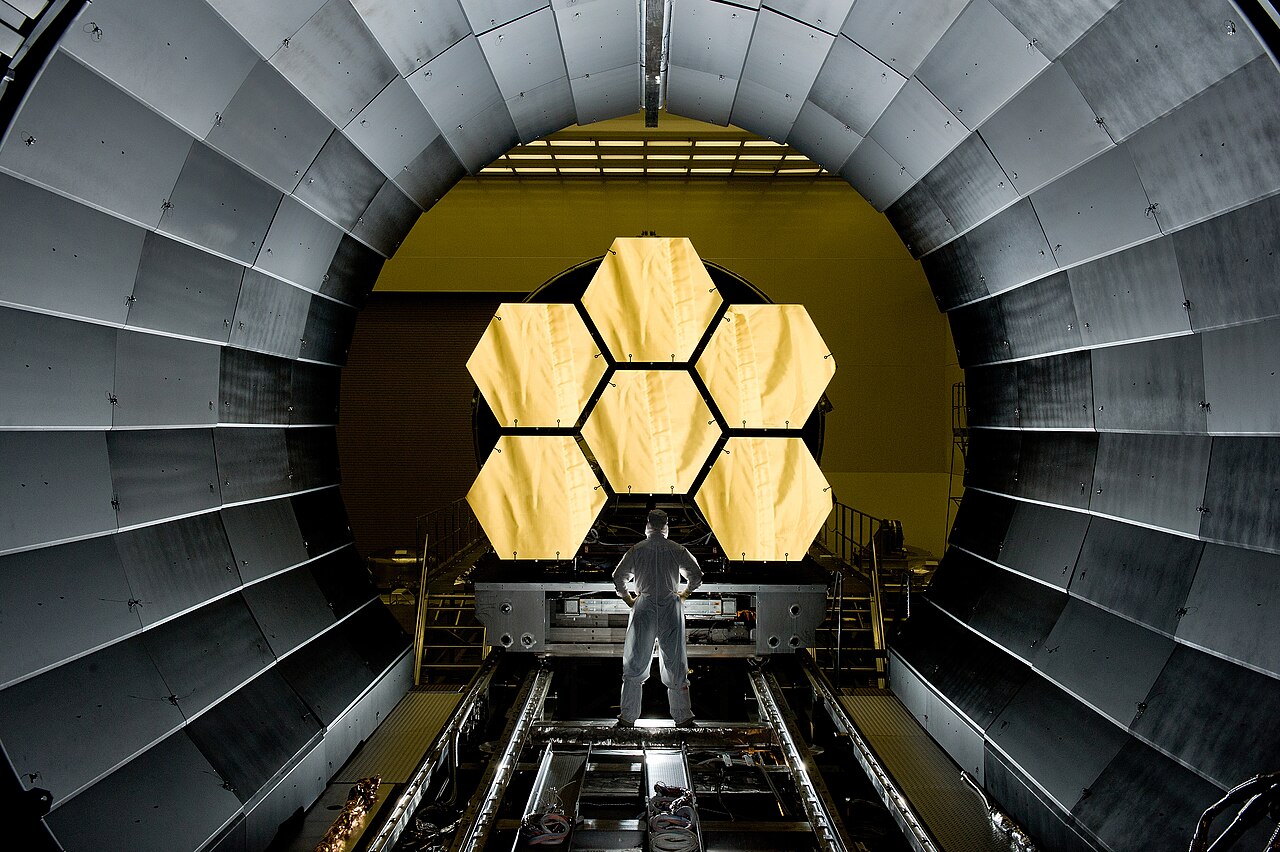
Start with the machine itself, briefly. Webb is an infrared observatory with a 6.5-metre primary mirror made of 18 gold-coated beryllium hexagons, folded for launch and unfurled in space. It sits near the second Lagrange point, about 1.5 million kilometres from Earth, shielded from the Sun by a tennis-court-sized five-layer screen so its instruments can cool to below minus 220 degrees Celsius. Infrared matters because the expansion of the universe stretches light from the earliest galaxies out of the visible range entirely; Hubble simply cannot see them. The Ariane 5 launch on Christmas Day 2021 was so accurate that fuel reserves now suggest twenty-plus years of operation rather than the ten originally budgeted.
The first upended assumption came almost immediately. Models of galaxy formation predicted that the earliest galaxies would be small, faint and rare, assembling gradually from gas over the first billion years. Webb instead found the early universe crowded with bright, well-formed galaxies. The current record-holder, JADES-GS-z14-0, has a spectroscopically confirmed redshift of 14.3, meaning its light left it roughly 290 million years after the Big Bang, and it is both large and luminous for that epoch. Alongside these came a population nicknamed "little red dots", compact red objects that may be galaxies hosting oversized black holes. None of this breaks the Big Bang model, despite excitable early claims, but it does mean star formation in the first few hundred million years was far more efficient than theorists had allowed, and the textbooks on how galaxies assemble are being rewritten rather than annotated.
The second shift is in exoplanets. Before Webb, knowing the composition of a planet's atmosphere hundreds of light years away was mostly aspiration. The technique, transmission spectroscopy, is conceptually simple: when a planet crosses its star, a sliver of starlight passes through the planet's atmosphere, and molecules in that atmosphere absorb characteristic wavelengths. Webb's sensitivity turned this from a marginal exercise into routine chemistry. On the hot Saturn-sized planet WASP-39b it delivered the first unambiguous detection of carbon dioxide in any exoplanet atmosphere, followed by sulphur dioxide, a molecule produced when starlight drives chemical reactions, the first evidence of photochemistry beyond our solar system. Rocky worlds are harder; surveys of the TRAPPIST-1 system suggest its innermost planets are probably bare rock, itself a sobering data point for how common atmospheres are around red dwarf stars.
The British hardware inside it
Webb is routinely described as a NASA telescope, but one of its four instruments is substantially British. MIRI, the Mid-Infrared Instrument, was built by a European consortium of more than 20 institutes led from the UK Astronomy Technology Centre in Edinburgh, with the optical bench assembled and tested at RAL Space at Harwell in Oxfordshire and science leadership shared with the University of Arizona. MIRI observes at wavelengths from 5 to 28 microns, longer than any other instrument aboard, which makes it the tool of choice for peering into dust-shrouded star-forming regions and for studying the cool discs where planets condense. When Webb images show newborn planetary systems carving gaps in their discs, that is largely Edinburgh's and Harwell's engineering at work.
What it has not settled
Honesty requires the other column. Webb has not resolved the Hubble tension, the stubborn mismatch between the universe's measured expansion rate today and the rate inferred from the early universe; its cross-checks of Hubble's stellar distance measurements confirmed they were sound, deepening the puzzle rather than closing it. A widely reported hint of dimethyl sulphide on the planet K2-18b remains contested, with reanalyses finding the signal too weak to claim. That pattern is the fairest summary of the mission so far: fewer miracles than the press releases implied, but a handful of solid, replicated results that forced real revisions. For a £8 billion instrument, forcing the models to change is exactly the job.